
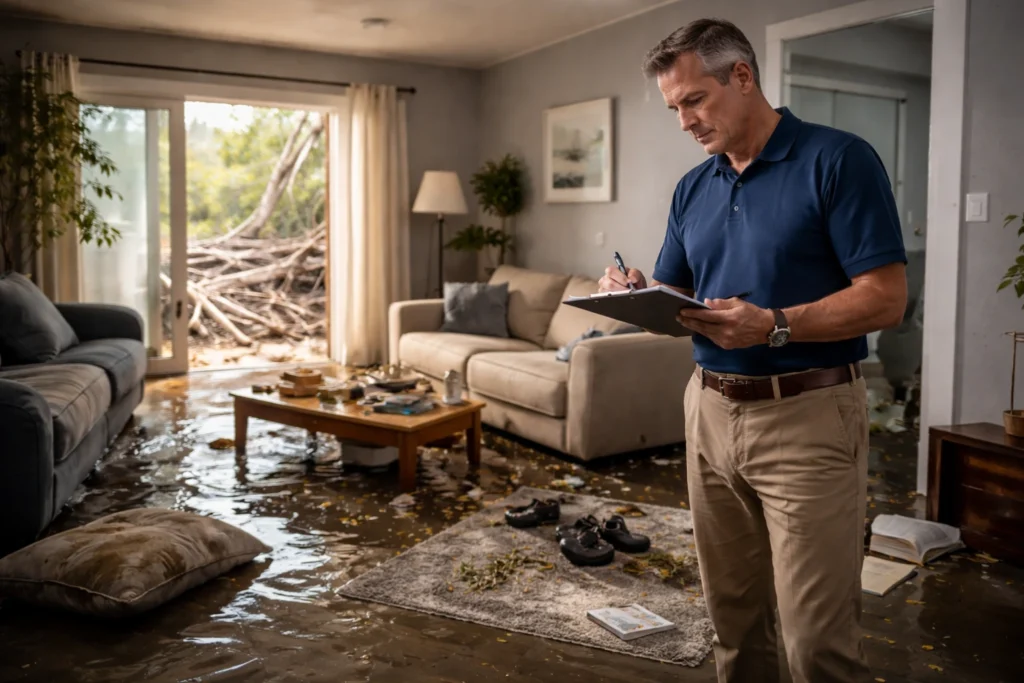
Flood damage hits fast. The cleanup drags on. And the paperwork? That can feel endless.
If you’re filing a claim after rising water invades your home or commercial property, working with a public adjuster for flood insurance may be the difference between a rushed payout and a fully documented, properly valued settlement. Especially here in San Angelo, where sudden heavy rainfall and flash flooding can overwhelm even well-prepared property owners.
Flood insurance is not like a typical homeowners policy. The rules are stricter. The documentation standards are tighter. The deadlines are non-negotiable. And once the water recedes, the clock starts ticking.
Let’s break this down clearly, step by step, so you understand how to protect your claim — and your financial recovery.
Understanding Flood Insurance in Texas
Before you can protect your claim, you need to understand what you’re actually working with.
What Counts as a “Flood”?
Under most policies, a flood is defined as:
- A temporary condition of partial or complete inundation
- Affecting two or more acres of normally dry land or two or more properties
- Caused by overflow of inland waters, unusual accumulation of surface water, or mudflow
That means rising water from heavy rain or river overflow qualifies. A broken pipe inside your home does not.
That distinction matters. A lot.
The National Flood Insurance Program (NFIP)
Most flood insurance policies in San Angelo are issued through the National Flood Insurance Program (NFIP), administered by Federal Emergency Management Agency.
Here’s what you need to know:
| Coverage Type | Maximum Limit (Residential) |
| Building Property | $250,000 |
| Personal Property | $100,000 |
There are also:
- 30-day waiting periods (in most cases)
- Strict Proof of Loss deadlines (typically 60 days)
- Specific exclusions (finished basements are a common surprise)
The NFIP policy language is rigid. There is little flexibility. If something is not documented properly, it may not be paid.
This is exactly where a public adjuster for flood insurance becomes critical.
Private Flood Insurance Policies
Private flood insurance exists too. These policies sometimes offer:
- Higher coverage limits
- Additional living expense coverage
- Replacement cost on contents
But here’s the catch: private policies vary widely. They must be interpreted line by line. One overlooked clause can mean thousands left unclaimed.
A skilled public adjuster for flood insurance reviews the entire policy before a single number is submitted to the carrier.
Why Flood Insurance Claims Are So Complicated
Flood claims are documentation-heavy. Precision matters. Estimates must be detailed and supported.
Let’s talk about what often goes wrong.
1. Strict Documentation Requirements
You must submit:
- Detailed repair estimates
- Itemized personal property inventories
- Photographic evidence
- Proof of Loss forms signed and sworn
Miss the deadline? You may lose rights to payment.
Underestimate damage? You can’t easily reopen it later.
2. Building vs Contents Confusion
Flood insurance separates coverage into two categories:
Building Property:
- Foundation elements
- Electrical and plumbing systems
- HVAC equipment
- Permanently installed flooring
Personal Property:
- Furniture
- Clothing
- Electronics
- Appliances not built in
Many homeowners mix these categories. Insurance companies do not.
A public adjuster for flood insurance makes sure everything is placed correctly and valued appropriately.
3. Depreciation and Scope Issues
Flood policies often apply depreciation to contents.
If your 5-year-old couch is damaged, you may receive actual cash value, not replacement cost — unless your policy says otherwise.
Under-scoping is another common issue. Hidden moisture inside walls, insulation saturation, electrical corrosion — these are frequently missed in initial inspections.
That omission can cost you.
What Does a Public Adjuster for Flood Insurance Actually Do?
Let’s get practical.
A public adjuster for flood insurance works for you — not the insurance company. Their role is to:
- Interpret your policy
- Inspect and document damages
- Prepare a comprehensive estimate
- Submit required forms
- Negotiate the settlement
Here’s what that looks like in action.
Policy Review and Coverage Analysis
Before anything else, your adjuster reviews the entire flood policy.
Not just the declarations page. The full document.
They identify:
- Coverage limits
- Deductibles
- Exclusions
- Extensions
- Endorsements
This prevents you from leaving legitimate coverage untouched.
Full Damage Assessment
Flood damage isn’t always visible.
Water seeps. It lingers. It weakens materials from the inside out.
A professional evaluation includes:
- Subfloor moisture readings
- Drywall saturation depth
- Insulation contamination
- Electrical system impact
- Foundation movement concerns
San Angelo properties, especially those with slab foundations and shifting soil conditions, require careful structural evaluation.
Detailed Claim Preparation
This is where value is either built or lost.
A proper claim file includes:
- Line-by-line repair estimates
- Room-by-room damage breakdown
- Full contents inventory with age and value
- Supporting documentation and photos
- Accurate Proof of Loss submission
Insurance carriers review flood claims with precision. So must you.
A public adjuster for flood insurance ensures nothing is vague. Nothing is incomplete.
Negotiation with the Insurance Carrier
Insurance company adjusters represent the insurer. That’s their role.
If their estimate misses items, underprices materials, or excludes covered damage, someone must respond.
That someone should be experienced.
A public adjuster for flood insurance challenges under-scoped items, supports supplemental claims, and manages re-inspections when needed.
Why San Angelo Property Owners Should Take Flood Claims Seriously
Flooding isn’t just a coastal issue.
San Angelo experiences:
- Flash floods after heavy rainfall
- Concho River overflow risks
- Rapid surface water accumulation during storms
Properties near low-lying areas are particularly vulnerable.
West Texas soil conditions also contribute to structural shifts after saturation. Foundations can crack. Slabs can settle unevenly.
These issues must be evaluated and documented correctly.
Commercial property owners face even greater exposure.
Commercial Flood Claims Add Complexity
For businesses, flood damage often involves:
- Equipment loss
- Inventory contamination
- Machinery damage
- Operational downtime
Flood policies typically do not include business interruption under NFIP coverage. Some private policies do.
A public adjuster for flood insurance evaluates these distinctions early, before mistakes are made.
When Should You Hire a Public Adjuster?
Timing matters.
Here’s a simple guide:
| Situation | Should You Call? | Why |
| Immediately after flood | Yes | Documentation must begin quickly |
| Already filed claim | Yes | Supplemental claims may be possible |
| Low initial offer | Yes | Scope review needed |
| Partial denial | Yes | Dispute process required |
| Minor cosmetic damage only | Maybe | Cost-benefit evaluation |
The earlier a public adjuster for flood insurance becomes involved, the stronger the documentation tends to be.
How a Public Adjuster Protects Claim Value
Let’s get specific.
Hidden Structural Damage
Water below flooring can:
- Weaken subfloors
- Cause long-term rot
- Compromise insulation
- Corrode electrical components
If not identified early, these damages can become your financial burden later.
Preventing Under-Scoping
Insurance estimates sometimes miss:
- Baseboard removal
- Cabinet toe kick damage
- Vapor barrier replacement
- Insulation replacement behind drywall
- Electrical outlet corrosion
These small line items add up quickly.
Accurate Depreciation Calculations
Depreciation must be calculated correctly. Some items may qualify for replacement cost under certain policies.
An experienced public adjuster for flood insurance reviews depreciation schedules carefully to avoid unnecessary reductions.
What Working With a Public Adjuster Looks Like
Here’s the typical process:
- Initial Consultation – Review loss and policy basics
- Policy Analysis – Detailed coverage review
- On-Site Inspection – Comprehensive damage documentation
- Estimate Preparation – Line-by-line scope creation
- Claim Submission – Proper documentation filing
- Carrier Negotiation – Responding to insurer feedback
- Settlement Review – Ensuring final payout matches documented damage
Clear. Structured. Strategic.
What Does It Cost?
Most public adjusters in Texas work on a contingency fee.
That means:
- No upfront payment
- Percentage-based fee (typically between 5–15%)
- Payment only if settlement is secured
This structure aligns incentives. If your claim increases appropriately, both parties benefit.
Choosing the Right Public Adjuster in San Angelo
Not all adjusters specialize in flood claims.
When evaluating options, ask:
- Are you licensed in Texas?
- How many flood claims have you handled?
- Do you understand NFIP guidelines?
- Can you provide references?
Flood claims are technical. Experience matters.
Final Thoughts: Protect the Claim Before It’s Too Late
Flood damage is overwhelming. The cleanup alone is exhausting. Add insurance paperwork on top of that, and it’s easy to rush decisions.
But flood claims are not forgiving.
Deadlines are strict. Documentation standards are high. Mistakes are expensive.
Working with a public adjuster for flood insurance ensures your claim is documented properly, submitted correctly, and negotiated strategically. Especially in San Angelo, where flash flooding and regional soil conditions create complex damage scenarios, professional representation can protect both immediate repairs and long-term structural integrity.
If you’ve experienced flood damage, don’t guess your way through the process. Don’t assume the first estimate is complete. And don’t wait until the claim closes to discover something was missed.
Flood claims demand precision.
And precision protects settlements.